Mushroom Tincture vs Powder vs Gummies: What’s the Difference?
Functional mushrooms are everywhere right now.
You can find them in tinctures, powders, capsules, gummies, coffee blends, chocolate bars, drink mixes, and just about every wellness product imaginable.
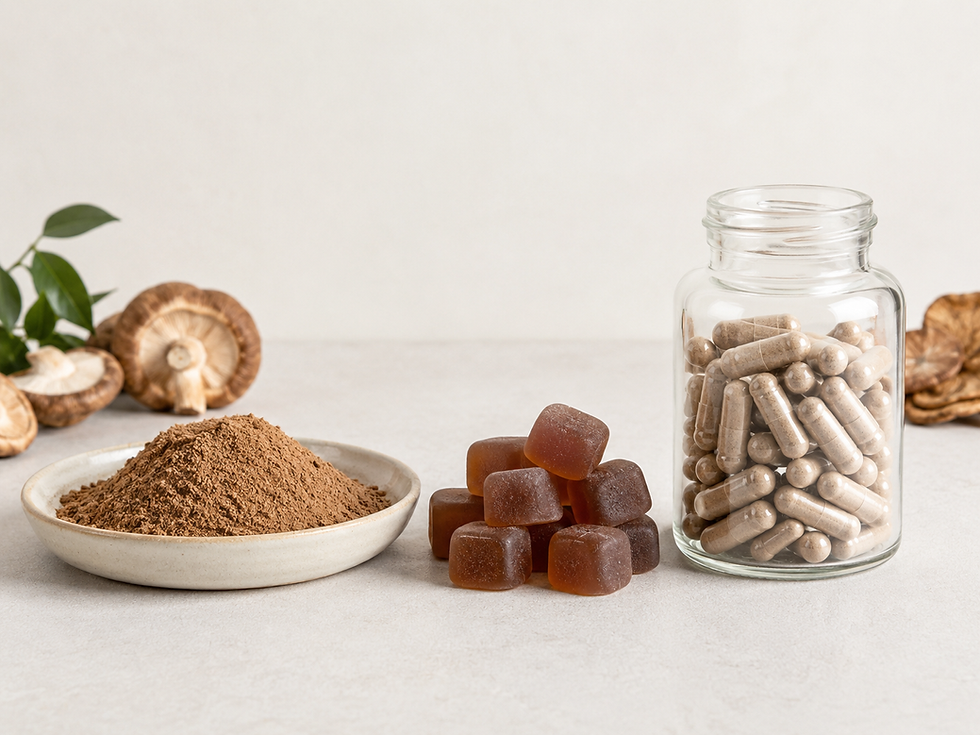
At first glance, it can feel like they are all doing the same thing. After all, if the label says Lion’s Mane, Reishi, Cordyceps, Turkey Tail, or Shiitake, does the format really matter?
The answer is yes.
The format matters, but maybe not for the reason most people think.
The real question is not whether a mushroom product is liquid, powdered, sweetened, encapsulated, or mixed into coffee. The better question is this:

Was the mushroom properly prepared so your body can actually use what is inside?
That is where the difference between a mushroom tincture vs powder becomes important.
At Boxed-In Mushroom Company, we believe functional mushroom products should be made clearly, slowly, and honestly. No vague marketing. No mystery blends. No shortcuts hidden behind trendy packaging. Just real mushrooms, careful extraction, and a process you can understand.
Mushroom Tincture vs Powder: The Basic Difference
The simplest difference is this:
A mushroom powder is usually dried mushroom material that has been ground into a powder.
A mushroom tincture is a liquid extract made by pulling compounds from the mushroom into alcohol, water, or both.
That may sound simple, but it makes a big difference.
Mushrooms are not like leafy herbs. Many of their valuable compounds are locked inside tough cell walls made of chitin. Chitin is the same structural material found in things like insect shells and crustacean shells. Humans do not digest chitin very efficiently on our own.
That is why preparation matters.
If a mushroom product is just raw dried mushroom ground into powder, your body may not have easy access to everything inside it. Heat, water, alcohol, time, and extraction method all affect what becomes available in the final product.
This is why we always come back to the same point:
A mushroom product is only as good as the process behind it.
What Is a Mushroom Tincture?
A mushroom tincture is a liquid extract.
In traditional tincture making, alcohol is used to extract certain compounds from plant or mushroom material. With mushrooms, water also plays an important role because some important mushroom compounds are water-soluble.
That is why many quality mushroom tinctures are dual extracted.
A dual-extracted mushroom tincture uses both alcohol and water to pull different types of compounds from the mushroom. Alcohol extracts certain alcohol-soluble compounds, while hot water helps extract water-soluble compounds.
At Boxed-In Mushroom Company, we use a strict 8-week dual extraction process. We use real fruiting bodies, certified organic cane alcohol, and a careful hot water extraction before recombining and proofing the final tincture to 30% ABV.
We do not rush it.
We do not outsource it.
We do not hide the process.
That is the difference between a tincture made as a product and a tincture made as a standard.
What Is Mushroom Powder?
Mushroom powder can mean several different things.
Some powders are simply dried mushrooms that have been ground up. Others are hot water extracts that have been dried into powder. Some are spray-dried extracts. Some are blended with fillers, starches, flavorings, sweeteners, or other ingredients.
That means “mushroom powder” is not one single thing.
A high-quality mushroom extract powder can be useful. But a basic ground mushroom powder is not the same as an extracted product.
This is where customers can get confused.
A label may say “mushroom powder,” but that does not automatically tell you whether the mushroom was extracted, how much was used, what part of the mushroom was included, or what else is in the container.
When comparing mushroom tincture vs powder, you want to look beyond the front label.
Ask:
Was it extracted?
Was it made from fruiting bodies?
Does the company explain the process?
Are there fillers or sweeteners?
Is the serving size clear?
Do you know how much mushroom was actually used?
If the answer is hard to find, that tells you something.
What About Mushroom Gummies?
Mushroom gummies are popular because they are easy.
They taste good. They are familiar. They feel simple. For someone who does not like the taste of tinctures or powders, gummies may feel like an easy entry point.
But gummies also raise some important questions.
Most gummies require sweeteners, flavors, binders, stabilizers, and other ingredients to hold their shape and taste pleasant. That does not automatically make them bad, but it does mean the mushroom extract is only one part of the product.
With gummies, you should ask:
How much mushroom extract is actually in each gummy?
Is it a real extract or just mushroom powder?
How much sugar or sweetener is included?
Is it a blend, and if so, how much of each mushroom is actually present?
Does the company explain the extraction method?
The convenience of a gummy can be appealing. But convenience should not replace clarity.
If the mushroom is buried inside candy-like formatting and vague dosage language, it becomes harder to know what you are really taking.
What About Mushroom Capsules?
Capsules can be useful for people who want something tasteless and simple.
They are easy to travel with. They are familiar. They remove the flavor issue entirely.
But just like powders and gummies, capsules depend heavily on what is inside them.
A capsule could contain a quality mushroom extract powder. It could also contain basic ground mushroom material, fillers, flow agents, or a blend that does not clearly show how much of each mushroom is included.
The capsule itself is not the issue. The issue is transparency.
If you are choosing capsules, look for clear information about:
The mushroom species
Fruiting body vs mycelium
Extract ratio
Extraction method
Serving size
Added ingredients
Testing or quality standards
Without that information, it is hard to compare products fairly.
What About Mushroom Coffee?
Mushroom coffee and drink mixes are some of the trendiest products in the functional mushroom space.
They are convenient and easy to add to an existing routine, especially for people who already drink coffee every morning. But mushroom coffee has a limitation.
It is often built around flavor, convenience, and habit first. The mushroom portion may be relatively small, blended with other ingredients, or not clearly explained.
Also, coffee comes with caffeine. That can make it harder to tell what you are actually feeling.
If you drink mushroom coffee and feel more alert, is that from the mushrooms, the caffeine, the ritual, or all of the above?
That does not mean mushroom coffee has no place. It just means it may not be the clearest way to understand how a specific functional mushroom fits your body and routine.
With a single-species tincture, the experience is more direct.
You know what mushroom you are taking.
You know the serving size.
You know the process.
You are not guessing through a long ingredient list.
Why Extraction Matters More Than Format
This is the most important point in the whole conversation.
The real debate is not simply mushroom tincture vs powder, tincture vs gummy, or tincture vs capsule.
The real issue is extraction.
Mushrooms need to be properly prepared. If they are not, the product may look impressive on the shelf but still leave customers wondering what they are actually getting.
A well-made mushroom tincture should explain:
What mushroom is used
What part of the mushroom is used
How it is extracted
What alcohol is used
How long the process takes
What the finished alcohol percentage is
How much to take
At Boxed-In Mushroom Company, we make single-species functional mushroom tinctures because we want people to understand exactly what they are taking.
Our tinctures are not mystery blends.
They are not rushed.
They are not built around trendy filler ingredients.
They are made from the mushrooms themselves, extracted slowly and carefully, with a process we are proud to talk about.
Why We Make Single-Species Mushroom Tinctures
A lot of mushroom products are blends.
You may see one bottle with Lion’s Mane, Reishi, Cordyceps, Turkey Tail, Shiitake, Chaga, Maitake, and several other ingredients all listed together.
That can sound impressive, but it also creates a question: How much of each mushroom are you actually getting?
At Boxed-In Mushroom Company, we focus on single-species tinctures because we believe clarity matters.
If you are taking Lion’s Mane, you should know you are taking Lion’s Mane.
If you are taking Reishi, you should know you are taking Reishi.
If you are taking Cordyceps, Turkey Tail, or Shiitake, you should be able to understand how each one fits into your routine.
At Boxed-In Mushroom Company, we focus on mushrooms we can grow and harvest ourselves because that gives us control from the very beginning. We know how they were grown, when they were harvested, how they were handled, and exactly what goes into the tincture process.
That is one reason we do not make Chaga tincture. Chaga is typically wild-harvested, and while it is a well-known mushroom, wild harvesting removes a level of control that matters to us. We cannot oversee the growing conditions, the environment, the harvest timing, or the handling in the same way we can with mushrooms we cultivate ourselves.
For us, quality starts before extraction ever begins. It starts with the mushroom itself. That is why we choose to work with mushrooms we can stand behind from grow room to dropper bottle.
Single-species tinctures make it easier to listen to your body, adjust your routine, and understand what works for you.
Fruiting Bodies Matter Too
Another major difference between mushroom products is whether they are made from fruiting bodies or mycelium.
The fruiting body is the part most people recognize as the mushroom. It is the actual mushroom structure that grows and produces spores.
Mycelium is the root-like network that grows through the substrate.
Both have a place in the mushroom world, but they are not the same thing.
At Boxed-In Mushroom Company, we use fruiting bodies in our tinctures because we want the mushroom itself to be the foundation of the extract. That choice is part of our standard.
When you are comparing products, look for clear language.
Does the company tell you whether they use fruiting bodies, mycelium, or both?
Do they explain why?
Are they transparent about the substrate or growing process?
Those details matter.
Why We Use Certified Organic Cane Alcohol
Alcohol is not just an ingredient in a tincture. It is part of the extraction process.
We use certified organic cane alcohol made from sugar cane. We do not use grain alcohol from corn, wheat, barley, or rye.
That choice matters to us because we want a clean, intentional ingredient base. Some customers prefer to avoid grain alcohol, and others simply appreciate knowing exactly what is in the bottle.
Our finished tinctures are carefully proofed to 30% ABV.
We believe customers deserve that level of transparency.
If a tincture company does not tell you what kind of alcohol they use, that is a fair question to ask.
Which Format Is Best?
The best format depends on what you value most.
If you want convenience and no taste, capsules may appeal to you.
If you want something easy to mix into smoothies or recipes, powders may make sense.
If you want something sweet and simple, gummies may feel approachable.
If you want a direct, traditional, easy-to-dose liquid extract, tinctures are a strong choice.
For us, tinctures make sense because they allow us to honor the mushroom, control the extraction, and create something simple enough to use every day.
A tincture does not need flavoring.
It does not need sugar.
It does not need to pretend to be candy.
It can simply be what it is: a carefully made liquid extract.
How to Choose a Better Mushroom Product
No matter what format you choose, look for transparency.
A good mushroom product should make it easy to understand what you are buying.
Before choosing a mushroom tincture, powder, gummy, capsule, or coffee, ask:
What mushroom species is used?
Is it single-species or a blend?
Is it made from fruiting bodies?
Was it extracted?
What kind of extraction was used?
Are there fillers, sweeteners, or flavorings?
Is the serving size clear?
Does the company explain the process?
Can you tell who made it?
That last question matters more than people think.
When you know who made your product, how it was made, and why it was made that way, you are no longer just buying a supplement. You are choosing a standard.
The Boxed-In Standard
At Boxed-In Mushroom Company, we make functional mushroom tinctures slowly and intentionally.
We grow the mushrooms.
We use fruiting bodies.
We use certified organic cane alcohol.
We follow a strict 8-week dual extraction process.
We make single-species tinctures so customers can understand what they are taking.
We proof the finished tincture to 30% ABV.
We keep our process small, hands-on, and transparent.
That is our standard.
Not because it is the fastest way.
Not because it is the easiest way.
Because if something is worth taking every day, it is worth making well.
Final Thoughts: Mushroom Tincture vs Powder Comes Down to Clarity
So, when comparing mushroom tincture vs powder, gummies, capsules, or coffee, the format is only part of the story.
The bigger question is quality.
Was it extracted properly?
Do you know what mushroom was used?
Do you know what part of the mushroom was used?
Do you know what else is in the product?
Do you trust the process?
A beautiful label does not always mean a better product. A trendy format does not always mean a better extract.
For us, mushroom tinctures remain one of the clearest, most traditional, and most honest ways to work with functional mushrooms.
They are simple.
They are direct.
They are easy to use.
And when made well, they give you a clear way to bring functional mushrooms into your daily routine.
Ready to Try a Functional Mushroom Tincture?
Our functional mushroom tinctures are made in small batches using real mushroom fruiting bodies, certified organic cane alcohol, and our strict 8-week dual extraction process.
Choose from Lion’s Mane, Reishi, Cordyceps, Turkey Tail, and Shiitake.
No mystery blends.
No grain alcohol.
No rushed extraction.
Just real mushrooms, made with care.


